Music Of The Light

music of the spheres

He’d drunk too much, but not enough, the times demanded more,
Cursed the shadows, cursed the lights, cursed the church’s open door,
Which faced him through the window of the only local bar,
Where satisfaction never was, you know how people are.

The voices swirled around him, sharing chit and chat,
Women, men, and in-betweens, a bit of this and that,
But most were young so talked of plans, or of their hopes for love,
Though one young man demanded answers, from his missing God above,

The drunk sat there, drinking, and vowed to drink again,
Told the barman it was his right, his need, to numb the pain,
Which through soul and mind, had spread,
Had sapped his will, had filled his thoughts with dread.

Just then he saw a shadow pass across the evening moon, 
And wondered if it were just a cloud, or eclipse that came too soon,
Or perhaps a sign of darker times when the lights would quickly dim,
But decided it was, instead, imagination’s whim.

De Vere once posed the question, but no answer did provide,
For who can judge if life is best, when they have never died,
So when the barman loudly said, to startle those around,
“The play is in the final act, the hare does chase the hound.”

Upright sat the drunk right quick to raise his glass in hand,
“To you, my friend, who sees it all, the wisest in the land,
Our world is gone, has disappeared, old Chaos reigns once more,
And Death, her dear companion, has opened wide the door,”

The barman nodded in salute but others called him mad,
“Just an old eccentric who’s lost what he once had,
A bum, a jerk, an idiot, they should put him in a room,
We don’t need his stupid tales of endless woe and doom”

The drunken man ignored their words and retreated deep within,
Where tranquillity could there be found, far from their dismal din,
Then, refreshed, he left the place, to wander through the night,
Guided by that yearning to hear the music of the light.

The Man At The Church

Goya, man-war

I have the habit of going for a walk in the morning, walking silently, in safe solitude, simply breathing, legs stretching out, arms keeping time, feeling a different rhythm of life. It helps me deal with the increasing agitation I experience on hearing the daily news of wars, corruption, of people alienated from each other, from themselves, of a dying world.

My routine takes me up the paved road to the top of the hill, the hill that dominates the small Ontario town in which I live, which lies spread out along the river that winds its way south to the great lake. There, looking down over the valley below, sits a church, a cathedral almost, St. Mary’s, the Catholic church which dominates all the other churches in the town by its majesty, as if to show the protestants what a real church should look like. Sometimes, when the mood strikes me, I stop to look at it, to admire it, for though I am not a religious man, the ceremonies, the architecture, the art and iconography of the church are to me mysterious and beautiful. The rest of it creates no interest for me. I find my salvation in the nature that surrounds me, not in the mythology of its creation.

Or so I thought, until something happened that caused me to reconsider the mysteries of the world.

One day, in early June I think it was, the year of the great spring rains, I decided to get up earlier than usual to take my walk. I couldn’t sleep. The sun was rising. It promised to be a dramatic overture to the day; a blue sky covering green hills awash in bird songs sung in many different keys, accompanied by the soft rustling harmony of countless leaves whispering in the warming breeze.

The locals of the town were beginning to stir. The occasional vehicle, a pickup truck, a run-down car, passed me by on the way to market or work, but no one else was walking along the street that led from my house to the main street, then up the hill heading towards the edge of town and the tower of St. Mary’s that held the big bell; the bell that rang out several times a day calling the faithful to prayer.

When I got to the top of the hill and stood in the shadow of the entrance to the church with its big wooden double doors, flanked on each side by a Norman tower graced with several stained glass windows, the left tower with the spire and cross at its top, the right containing the bell, I paused in my walk, put my hands in my pockets, looked up to the bell tower and wondered just how big that bell was. It was while pondering this question that I heard the clunky thud of the church doors opening and closing and on looking over I saw a figure coming towards me dressed in the black habit and black beard of a Jesuit, which struck me as odd as there were no Jesuits in the parish that I had heard of.

I could not see his face. It was hidden in the shadows of the old fashioned cowl he had covering his head. He approached me slowly with a steady step until he stood in front of me. For some reason, the angle of the sun, the weight of his cowl, I could not see his face apart from the black beard, tight, grim lips, the tip of a hooked nose above the moustache. The rest vanished into the darkness of the hood he wore despite the warming of the day.

I greeted him with the usual “Hello; nice day, isn’t it?”, or some such thing that we say without thinking when meeting strangers. It gets muddled in my head now, but there was no response. The figure stood in front of me without moving, very still, like one of those human mannequins tourists are delighted by in Europe, a Marie Antoinette, a silver clown, or a marble Dante with his book. He seemed very solid at first, but then I noticed that his form shimmered in the light as do those mirages of dark water that lie across the road in the summer heat and vanish as soon as you see them.

The silence of this apparition, for so it seemed to be, unnerved me. I stepped back, took my hands from my pockets and prepared to retreat. But the form continued to stand there without a sound or movement. Now more unnerved, I challenged him with, “Are you all right Father? Can I help you?’

There was no sound, no movement, except for the subtle, almost undetectable, shimmer I referred to before, but then a voice that seemed to come from some distant place, some distant time, cried out, as if wailing at a death, “What have you done? What have you done?” And with that, the figure raised his right hand and pointed it, while turning his body, calling out all the while, “What have you done?”

He spoke in French, a language I understand, but with an accent I had not heard before. I still am not sure if I understood him correctly, but I was so transfixed by the voice and the movement as I followed his hand pointing at the world around us, that I seemed to comprehend him nevertheless and was surprised when a sudden feeling of intense melancholy swept over me. Tears filled my eyes, and I fell to the ground at his feet, overwhelmed by sudden grief.

He stopped turning, looked at me, lowered his hand, and bowed his head. He began to turn away from me. I reached out to try to stop him, but my hand passed through air. I struggled to my feet, wiping away the tears that still bathed my eyes, trying to restore my equilibrium, but he did not stop and kept walking back towards the doors, his shoulders and back bent, his head lowered and, through my own tears, I saw signs of a man sobbing uncontrollably. I managed to shout out, “Who are you?’ perhaps an unfair thing to ask when I was not even sure who I was.“Your name?” And protested, “I’ve done nothing, just lived.”

He stopped, turned his head to look at me over his shoulder and with a voice that came from a deep abyss said, again, “What have you done? What have you done? Terrible things, terrible things,” each word a moan, or so it seemed, as he turned his head away and walked slowly back to the door of the church where his shimmering figure merged with the door and dissolved into the shadows as if he had never been.

The encounter so disturbed me that I felt paralyzed for some seconds until I regained my senses and, shaken, decided to turn back towards home. As I walked slowly back into the town, I reflected on the melancholy encounter, what it meant, that question from the past demanding an explanation from the present, about our destruction of the future. For that was what it was. Of that I am sure.

Upon relating what happened to my wife, my friends, my doctor, explanations were quick in coming. My wife looked at me oddly. Some said outright I was a liar and pulling their leg. Some religious people took it as a proof of God, a warning from the Almighty, some as the visitation of an angel. The Catholics quickly claimed it as a miracle, proof of the true martyrdom of Jean De Breubeuf in 1649, whose ghost this undoubtedly was. I hear the matter has been raised at the Vatican, and the students of the local schools now discuss the work of the Jesuits in the area three hundred years ago. The Protestants, in protest, proclaimed it to be God’s clear condemnation of the Roman church. The new agers stated categorically that it was the manifestation of some spirit of nature, mourning its steady destruction, and, of course the psychiatrists, my psychiatrists, determined, on clinical evidence, that it was an hallucination, a psychotic episode; that I had experienced a break with reality. I cannot comment on these theories. When I try, my attempts are considered just more evidence that my mind is unbalanced. And who am I to say it is not.

Several months have since passed. I have learned now to keep quiet, to agree with them that I was ill but now am welI. I was finally allowed home after a long period of analysis, allowed to return to the birds, the sky, the whispering leaves, to again walk past the church on a warm spring or summer’s day, as if nothing had ever happened. But, each time I do, each time I see those doors, when the light is right, the sky is blue, the leaves whispering, and no one else is there, I still see the man at the church, and hear that ancient voice moaning and asking over and over again, “What have you done? What have you done? Terrible things, terrible things.”

    Destroyer of the World

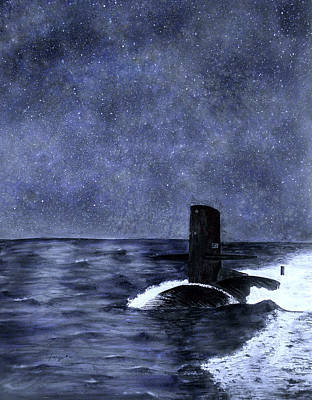
submarine

Before my eyes there spreads the sea, beyond the sea the sky,

The sea is black, is green, is grey, as winds rise high, or die,

The sky appears a soft blue veil, stitched with clouds of whitest light,

They turn a soft and rosy hue, when day withdraws for night.

And there, just there, a line appears, a slash of death, in waters deep,

A shark perhaps, or killer whale, why sailors’ widows weep,

A line cascading, foamy white, carved by knife-edged fin,

As though Good was hunting Evil, in depths of all our sin,

But then there breaches rounded back, but no strange whale is this,

The fin becomes a U-boat’s sail, the venting air, a hiss,

A klaxon screams, as water streams, from deck and missile pods,

The periscope and antennae are like tangled fishing rods,

Then men appear, in open hatch, who scan the sea and shore,

They seem relaxed, just taking air, as if there was no war,

But, with loud alarm, then hatches down, she slips beneath the waves,

To hide among the darkest deeps, as leopards hide in caves,

Death on edge, expectant, waiting for its cue,

For stealthy, silent, submarines know what they must do,

And so it’s gone, preparing soon, for rockets to be hurled,

They named it well, the madmen, Destroyer of the World.

  Our Emptiness

leonard_foujita_cafe

The sunlight dapples the blank waiting page,

From the window, shouts of children at play,

My bones remind me, to me a lost age,

A lone crow calls out-but what does he say?

The electric fan whirs through a hot, sultry day, 

Endlessly turning like a mechanical cage,

Brushing stale air from its spiraling blades,

As she walks through the room,

In a long silken dress, beauty in movement,

But not a word said-

Exchanging only our emptiness.

The House Was Old

Despair photo96022541

The house was old on top the hill

The trees all dead and withered,

As if some plague had entered there,

And death and demons gathered,

Yet something lured me through its door,

A longing, deep in me, for shadows,

As if my mind had come unhinged,

Shot through with poisoned arrows,

For around me spun a wicked world,

Where looming doom now hovered,

So on I moved through rooms decayed,

And saw in each a grotesque vision, 

Of such cruel, and vile and fiendish things,

Of madmen sprouting donkey ears, 

All braying in derision,

That my mind became untethered,

Until in one I saw a pale blue light,

That hung, in mid-air, somehow, humming,

And from it heard a distant song, now forgot,

That urged me on with constant thrumming,

To turn about and trace the path,

That wound back down that hill,

To find the land where beauty reigned,

And love, unknown except in legend, 

That, perhaps, could make us happy, 

But with each slow descending step,

There appeared new horrors – never-ending –

Until I reached a vast and empty plain,

A river through it wending,

And close nearby a single tree,

So old and gnarled and twisted,

Deformed it seemed, demented,

On which there hung, on rotting bough,

A silvered mirror, framed in gold,

In which the future was reflected,

Or so claimed an ancient crone, 

Who ancient stars collected,

In her temple of the damned,

But on looking in that glass so old,

I startled, shrieked, I moaned and shuddered,

For there, with gaping eyes I saw, too hideous to describe,

Too terrible to see,

That apelike thing they call mankind, leering back at me. 

.

A Litany

M

This is for those who struggle through life,

Alone, without help, so reach for the knife,

Who can’t take the troubles, the pain and the strife,

This is for those born poor without hope,

Fed images on screens of Prince Harry and soap,

Stopped before starting, so reach out for dope,

For the underpaid workers told to suffer with less,

By the men who enslaved them and created the mess,

And their fatuous wives, in their glittering dress,

For those driven mad by the twelve hour day,

Locked in a warehouse so dark they all pray,

To win the state lotto, can’t live on their pay,

For those in the office, bored out of their mind,

For the ignorant led by the morally blind,

And the many who know not how to be kind,

For those forced to vote for “democracies”.

Those vice-ridden totalitarian hypocrisies,

Whose voice is ignored, unless on their knees,

For the victims of charlatans, tricksters and whores,

Always surprised when they open the doors,

And in march the black shirts with their new nazi laws,

For the ones who resist, and are beaten or shot,

Or made to look fools, or just left to rot,

Thinking they’re heard, but simply they’re not,

For those who still believe that all will be well,

When we’ve made our planet a version of hell,

For that sound you hear, is the toll of the bell.

A Greeting From Existence

Leonid_Meteor

Stars glittered in the clear night sky while on my back I lay,

Gazing into infinity, enfolded in eternity, wondering of my way,

And wondered why I wondered, and why I could not say

Or speak those silent thoughts for which no words are fit,

And were they thoughts at all when they never could be writ,

Nor understood by anyone, like scrolls in an ancient pit,

Those mysteries of unknown minds, lost in buried time,

We’re anonymous in multitude, our voices locked in mime,

While priests tell us day and night our nature is a crime,

And force us with morality to lose our peace of mind,

When all we need is do no harm and to others just be kind,

Which martyrs walking stony paths would do well to keep in mind,

But then my thoughts were broken when a meteor arced across the sky,

A sudden flash and blaze of light was born and then did fade and die,

A greeting from Existence – a brightly waved good-bye.

Incident At Sakina

                 (An Arusha Story)

arusha city pic1

 I’m deep in the music, lost in the sound,

 foot beating the time, fingers playing the strings,

 that sing their soft song of f sharp to d,

 the notes in between, that lingering e,

 then came a shriek, then the screams, a quick rush of feet, 

 beneath the blue sky, through the green of the trees, 

 then a silence as loud as a lioness’ roar,

 that froze my fingers right on the edge, 

 heart pounding, just listening, to shouts, to loud moans,

 the running of feet, the noise of a crowd,

 then me running too, from door to the gate,

 to that scatter of rags that lay on the road,

 where we gathered in awe of the presence of  death;

‘mangoes, that’s what she sold,’ 

‘she was so old, and so poor,’

‘the car came haraka,’

‘he came at her fast, and disappeared quick,’ 

‘thrown high in the air.

 ‘like a leaf on the wind,”

“pole sana, so sorry’

“sikitika,”so sad,’

“vipi, dada? Unasaema?”

‘what’s up sister, you say what,’

“ay mbali sana,, ay very bad.’

‘hey what’s up with her brother?’

 “just dead, man, ala, this old Maasai,

 ‘twende, let’s go, look, forget it my brother,

 ‘life is too short and we gotta go,”

  so they left, the crying, the wailing, 

  the blood  pooled at our feet,

  as women pushed past me, then the police,

  all dressed in white and very polite,

  then we all turned away, to carry on life,

  without gods, a purpose, 

  to face out own fate.

An Angry Wind Is Coming

( A warning from the grave)

marx

An angry wind whips the trees, tears the leaves,

Claws them down, throws them up,

Then beats them through the air-Enraged,

So angry mobs like storms will come,

Upon the ones who reign ,

Who love, like flies, decay and death-

We know them from their stench,

The miseries they have made-

But what will be, this angry mob,

Of the left, or of the right,

A million Che Guevara’s or Mussolini’s spawn,

Bred in beds of ignorance and lousy with their hate,

Bringing worse upon us still, and with an iron fist?

The storm has come upon us, there’s thunder in the air,

Zola, now is never read, Neruda is reviled,

Saramago showed the Blindness, Sinclair, the Jungle of their kind,

Capital is forgotten and all the truth therein,

Where are they our heroes, when now we need them more?

Mac The Knife is back in power and works in dark of night,

And where are you my comrades, are you on the barricades,

Or wrapped in sad, self-pity, in doubt of what you are,

Caring more for you and yours, and less for us and ours?

An angry wind is coming, so get your selves prepared,

Be warned, and act, my comrades, or end up on your knees.